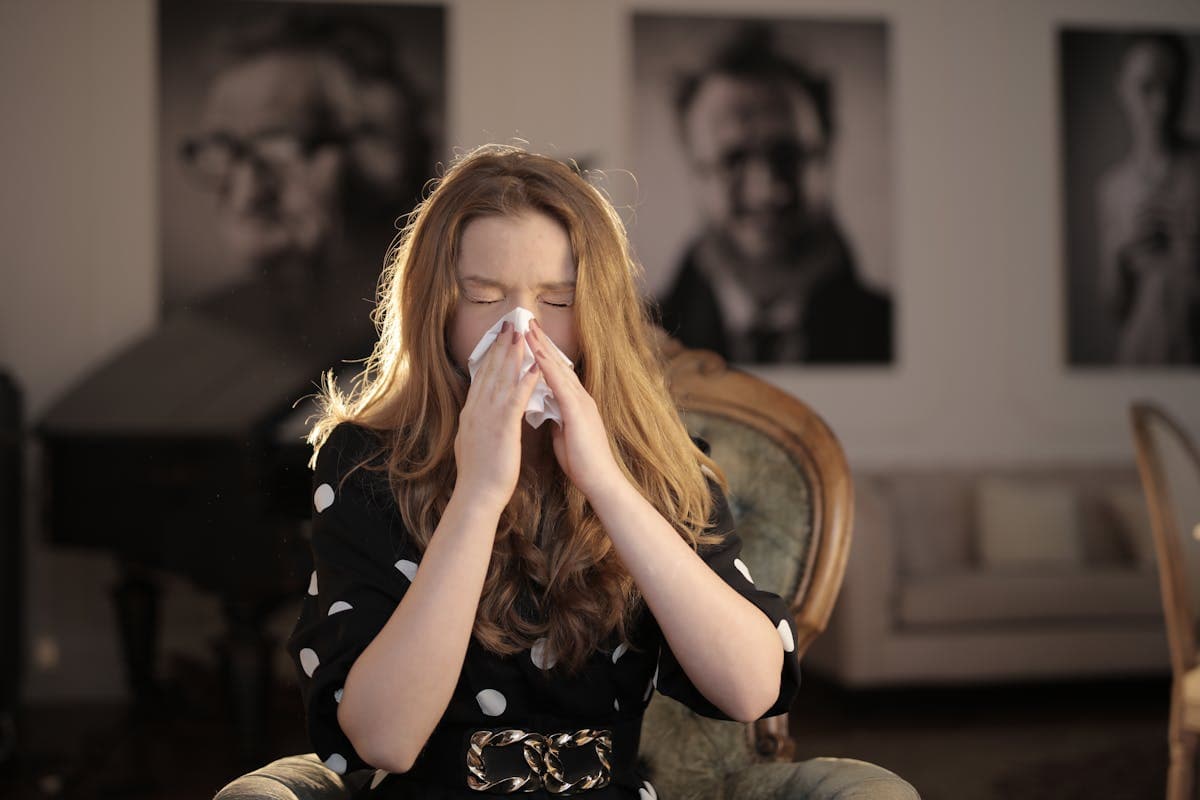
Nosebleeds in the Summer Heat: How to Stop One and When to Worry
A sweltering July afternoon, the thermometer pushing 33°C (91°F), and you’ve just stepped from the blazing street into an aggressively air-conditioned office. You reach for a tissue to dab your nose — and suddenly a bright red stain blooms on the white paper. Your heart quickens, because a nosebleed always looks more dramatic than it really is.
Stay calm. In the vast majority of cases a nosebleed is not dangerous and can be brought under control in a few minutes using simple measures you can do at home. The trouble is that most of us do exactly the wrong thing — we tilt our head back, stuff cotton wool into the nostril, and wait for it to “pass on its own.”
In this article we’ll walk you through the correct steps for stopping a nosebleed, explain why they happen more often in summer, show you how to care for your nasal lining afterwards, and — most importantly — tell you when a minor bleed is actually a sign that you need medical attention.
Why do nosebleeds happen more often in summer?
You might think nosebleeds are a winter thing, when radiator-dried air irritates the mucosa. That’s true, but summer has its own equally effective set of triggers that can damage the tiny blood vessels inside the nose.
Dry air from air conditioning
Air conditioning doesn’t just cool the air — it dries it out. In an air-conditioned room the nasal lining loses moisture, becomes thinner and more fragile. The small blood vessels just beneath the surface rupture more easily, sometimes with no obvious trigger at all.
Heat, sun, and dilated vessels
High temperatures cause blood vessels to widen — a natural cooling mechanism. Dilated, blood-filled capillaries in the nose are more prone to breaking. Prolonged sun exposure and overheating further increase that risk.
Dehydration
We sweat more in summer and often drink too little. A dehydrated body does a poor job of moistening all its mucous membranes, including the one in the nose. A dry lining is a dry lining, whether the temperature outside is freezing or 30°C.
Picking and rubbing the nose
It sounds trivial, but it’s one of the most common causes of nosebleeds, especially in children. When the lining is dry, scabs form and beg to be picked. Mechanically irritating a thin, dried-out membrane almost always ends in bleeding.
Where does the blood actually come from?
To understand why technique matters when stopping a bleed, it helps to know where the rupture usually happens. In the overwhelming majority of cases — estimated at over 90 per cent — blood comes from the front of the nasal septum, from an area called the Kiesselbach plexus (or Little’s area).
This is a small zone just inside the nostrils where several tiny blood vessels converge. It sits close to the surface beneath a thin mucosa and is easily reached — which is exactly why it reacts to dry air, nose-picking, or forceful blowing.
The good news: because the source is at the front, you can compress it effectively from the outside with your fingers. That is the entire basis of the correct first-aid approach. Bleeds from the back of the nose are far less common, usually much heavier, and require medical care — more on that in the warning-signs section below.
How to stop a nosebleed correctly — step by step
Memorise this sequence, ideally before you ever need it. Under stress, with blood dripping onto your shirt, clear thinking is hard — so it helps to have the steps already in your head.
- Sit down and stay calm. Do not lie down. Sitting upright with your head slightly lowered reduces blood pressure in the nasal vessels and makes it easier to stop the bleed.
- Lean your head FORWARD, not back. This is absolutely critical. Tilting slightly downward lets the blood flow outward rather than down your throat.
- Pinch the soft part of your nose. Using your thumb and index finger, firmly grasp the soft fleshy part just below the bony bridge and squeeze both nostrils together. You are pressing directly on the spot where the vessel has most likely ruptured.
- Hold for 10–15 minutes without releasing. This is the hardest part, because you’ll be tempted to check whether it has stopped. Don’t. Every time you ease the pressure you break the forming clot and the bleed restarts. Use a clock or timer.
- Breathe through your mouth. With your nose pinched shut this is natural — but good to know in advance so you don’t panic.
- Apply a cold compress. A bag of frozen peas or ice wrapped in a cloth held against the back of your neck or the bridge of your nose helps constrict the vessels.
- Spit out any blood that reaches your mouth. If a little blood trickles into your throat, spit it out — do not swallow. Swallowed blood can irritate the stomach and cause nausea.
After 10–15 minutes, gently release the pressure. If the bleed has stopped — great. If it is still seeping, repeat for another 10–15 minutes. If blood is still flowing after the second attempt, move on to the section “When to seek urgent care.”
Busting the myths — what NOT to do
A lot of folk wisdom has grown up around nosebleeds. At best, this advice does nothing; at worst, it makes things worse. Time to set the record straight.
How much does your basket cost?
See how much your basket costs across pharmacies — free, no registration
Compare pricesMyth 1: “Tilt your head back”
Probably the most widespread and most harmful piece of advice. Tilting your head back does not stop the bleed — it simply redirects blood down your throat. Swallowed blood irritates the stomach and can cause nausea and vomiting. Worse, the blood running down your throat makes it impossible to judge whether the bleed is actually slowing. Always lean forward.
Myth 2: “Stuff cotton wool or a tissue into the nostril”
Packing the nostril with cotton wool or a rolled-up tissue is a tempting reflex, but not a good idea. First, external compression with your fingers works better. Second, when you pull out the dried cotton wool you strip away the fresh clot and the bleed starts again. Third, fibres from the material can further irritate the lining.
Myth 3: “Lie down and you’ll feel better”
Lying down raises blood pressure in the vessels of the head and nose, which can actually intensify the bleed. You will also almost certainly swallow blood in that position. Stay seated with your head leaning forward.
Myth 4: “Blow your nose to clear the clots”
Forcefully blowing your nose immediately after a bleed (or during one) dislodges the forming clot and reopens a freshly sealed vessel. Treat your nose very gently for at least several hours after the bleed stops.
What to do AFTER the bleed stops
Stopping the bleed is only half the job. For the next few hours — or even days — the mucosa is weakened and vulnerable to re-bleeding. Here is how to look after it.
In the first few hours
- Do not pick or rub your nose. The clot is fragile and easily dislodged.
- Do not blow your nose for several hours; if you absolutely must, do so very gently.
- Avoid bending over, lifting heavy objects, or intense exercise — these raise pressure and increase the risk of re-bleeding.
- Skip the hot bath, sauna, and hot drinks for the rest of the day — heat dilates blood vessels.
Moisturising the nasal lining — the key to prevention
Because the main culprit in summer is a dried-out mucosa, keeping it moist is the single most important step to prevent future bleeds. At any pharmacy you can find several helpful over-the-counter products for this:
- Nasal moisturising gels and ointments — create a protective layer over the lining and prevent it from drying out. Applied thinly just inside the nostrils.
- Saline nasal sprays and sea-water mists — moisturise, cleanse, and support healing of the mucosa. Safe for regular and preventive use.
- Dexpanthenol-based preparations — available as ointments and nasal sprays, they support the repair of an irritated lining.
If you’re not sure which product to choose, ask your pharmacist — they can recommend something right for you or your child.
Look after air humidity and hydration
- Use a humidifier, especially in air-conditioned rooms and in the bedroom. Moist air means a less parched mucosa.
- Drink water regularly — a well-hydrated body moisturises its mucous membranes from the inside.
- Do not aim the air-conditioning or fan directly at your face.
- In summer, keep a saline nasal spray handy and use it whenever your nose feels dry.
Risk factors — who bleeds more easily?
Some people are more prone to nosebleeds. Knowing whether you fall into this group is useful, because prevention becomes especially important and certain situations call for extra vigilance.
- Blood-thinning medications — people taking anticoagulants or antiplatelet drugs (including aspirin) bleed longer and more heavily. If you take these medicines, always treat a nosebleed with extra caution.
- High blood pressure — elevated blood pressure predisposes to bleeds and can make them harder to stop.
- Dry or damaged nasal lining — chronic rhinitis, allergies, frequent use of decongestant nasal drops, or an air-conditioned work environment.
- Frequent infections and allergies — a runny nose, sneezing, and wiping all irritate the lining.
- Clotting disorders — inherited or acquired.
- Age — nosebleeds are most common in children and older adults.
When to seek urgent care
Most nosebleeds are harmless, but there are situations where self-treatment is not enough and medical help is needed. Contact a doctor or go to an urgent care clinic (or call emergency services in serious situations) if:
- The bleed does not stop after 20 minutes of correct, uninterrupted compression.
- The bleed is very heavy — blood is pouring rather than dripping.
- The bleed followed a head or facial injury — for example after a blow, fall, or accident.
- You take blood-thinning medication (anticoagulants, antiplatelets, aspirin) and the bleed will not stop.
- Nosebleeds keep coming back — recurring frequently without an obvious cause.
- The bleed is accompanied by dizziness, weakness, pallor, or heart palpitations — these may signal significant blood loss.
- You feel blood running mainly down your throat despite leaning forward — this may suggest a posterior bleed, which needs specialist assessment.
- You have difficulty breathing or other worrying symptoms alongside the bleed.
Do not hesitate to seek help. It is far better to ask a specialist and be told everything is fine than to ignore a heavy or unusual bleed.
Nosebleeds in children — a note for parents
Nosebleeds are very common in children and are almost always completely harmless. The main causes are nose-picking, a dry lining, infections, and minor knocks. The first-aid steps are the same as for adults, but a few extra points are worth keeping in mind.
- Stay calm — a child who sees you composed will be less frightened, and stress can intensify the bleed.
- Sit the child down, tilt their head forward, and gently but firmly pinch their nostrils together for 10 minutes.
- Teach the child to breathe through their mouth while their nose is pinched.
- Keep the lining moist — a saline spray and a humidifier in the child’s room can significantly reduce how often bleeds occur.
- Trim the child’s nails if they tend to pick their nose.
If your child’s nosebleeds are very frequent or heavy, appear after an injury, or come with bruising elsewhere on the body or general weakness — consult a paediatrician.
Frequently asked questions
Should I tilt my head back when my nose bleeds?
No, that is a common mistake. You should tilt your head FORWARD so blood flows outward and not down your throat. Swallowed blood can irritate the stomach and trigger nausea, and it also makes it impossible to gauge whether the bleed is easing. Sit down, lean forward, and pinch the soft part of your nose.
How long do I need to pinch my nose?
Pinch the nostrils firmly and continuously for 10–15 minutes, timing yourself on a clock. Do not release to “check,” as that breaks the forming clot. If the bleed has not stopped after the first attempt, repeat for another 10–15 minutes. No improvement after 20 minutes is a signal to contact a doctor.
Why do nosebleeds happen more often in hot weather?
In summer the main culprits are dry air from air conditioning, heat (which dilates blood vessels), dehydration, and picking a nose irritated by a parched lining. All these factors weaken the thin mucosa and make the tiny capillaries at the front of the nose more likely to rupture.
Are frequent nosebleeds dangerous?
Occasional bleeds that are easy to stop are usually nothing to worry about, especially in hot weather or when the lining is dry. But if they recur often, are heavy, appear without an obvious cause, or come with other symptoms such as weakness, bruising, or dizziness — it is worth seeing a doctor to find out why.
How can I prevent nosebleeds in hot weather?
The most important thing is to keep the nasal lining moist. Saline sprays, sea-water mists, and nasal moisturising gels or ointments all help. It is also worth using a humidifier (especially in air-conditioned spaces), drinking plenty of water, not aiming air conditioning directly at your face, and avoiding picking your nose.
Does aspirin increase the risk of a nosebleed?
Yes. Aspirin and other blood-thinning drugs — anticoagulants and antiplatelet agents — can make nosebleeds last longer and bleed more heavily. If you take these medicines and a bleed will not stop, treat the situation with extra caution and contact a doctor if needed. Do not stop taking prescribed medication on your own initiative.
Summary
✅ Sit down and lean your head FORWARD — never back, so blood does not run down your throat.
✅ Pinch the soft part of your nose for 10–15 minutes without releasing — the most effective way to stop a bleed from the front of the nose.
✅ Breathe through your mouth and apply a cold compress to the back of your neck or the bridge of your nose to help constrict the vessels.
✅ Do not stuff cotton wool in, do not swallow blood, do not lie down, and do not blow your nose immediately after the bleed.
✅ Afterwards, keep the lining moist — saline sprays, sea-water mists, nasal gels or ointments, and a humidifier are your best prevention tools in summer.
✅ Drink plenty of water and do not aim air conditioning at your face — dehydration and dry air are the main drivers of summer bleeds.
✅ See a doctor if the bleed does not stop after 20 minutes, is very heavy, followed a head injury, keeps coming back, comes with dizziness or weakness, or if you take blood-thinning medication.
Disclaimer
This article is purely educational and does not replace consultation with a doctor or pharmacist. It covers the management of typical, mild nosebleeds. For heavy or prolonged bleeds (more than 20 minutes despite compression), bleeds following a head injury, recurring bleeds, bleeds in people taking blood-thinning medication, or bleeds accompanied by worrying symptoms such as dizziness, weakness, or pallor — contact a doctor. In a life-threatening emergency, call your local emergency services. Before using any product, read the package leaflet and ask a pharmacist if you have any doubts.
One more thing: a summer medicine cabinet has its own logic. Alongside sun cream and electrolyte drinks, it is worth having a saline nasal spray, sea-water mist, and a nasal moisturising gel or ointment at home — to care for air-conditioned-dry mucosa before it ever bleeds. And since you’ll be picking up several products at once, do it smartly: with CheaperForDrug you can drop your whole summer basket into the comparison tool and see what the complete set costs across various online pharmacies. Real savings come from comparing the whole basket, not one spray at a time — because the pharmacy with the lowest price on a single item rarely wins across the board.
Keep your nasal lining moist from the start — and enjoy the summer without any unpleasant surprises on your tissue.